
Bottleneck Calculator
Our bottleneck calculator compares your CPU, GPU, and RAM using real benchmark data to check system balance. It shows if you have a CPU or GPU bottleneck and gives smart upgrade suggestions to improve gaming performance and overall PC efficiency.
PC Bottleneck Calculator
Analyzing Your System
Minimum Bottleneck (%)
0%
Recommended RAM
16 GB
Avg FPS
0 FPS
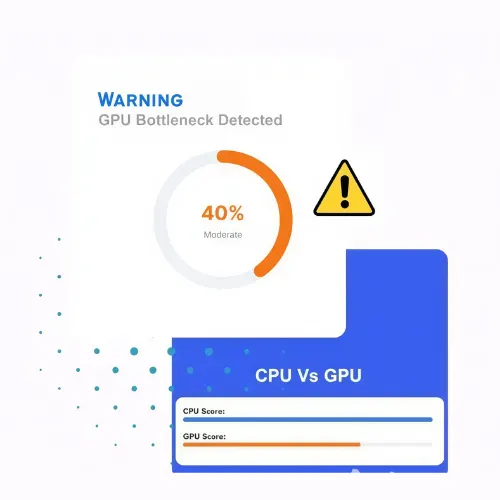
A bottleneck calculator checks how well your CPU and GPU work together and shows if one component slows down the other. If your CPU cannot keep up, you experience a CPU bottleneck that reduces FPS and causes frame drops. For advanced performance insights and enhanced analysis features, users can also access the Unlock Beta Server Account 2026 APK, which provides deeper system diagnostics and improved optimization tools.
If your GPU struggles, you get a graphics card bottleneck that limits visual performance. The tool uses benchmark data to measure compatibility and gives a clear bottleneck percentage so you know what holds your PC back. It also suggests smart upgrades, whether you need a better gaming CPU, a stronger GPU, or more RAM like 16GB or 32GB for smoother performance. This helps you avoid wasting money and build the best CPU and GPU combo for stable gaming and better productivity.
What is a Bottleneck?
A computer bottleneck happens when one hardware part slows down the whole system. Your PC works like a team, and if one part falls behind, everything runs slower. In gaming or video editing, this problem usually comes from a mismatch between the CPU and GPU. When they do not work at the same speed, you may see lag, low FPS, or slow loading.
A strong graphics card paired with a weak processor can cause a CPU bottleneck, while a powerful processor with a low-end GPU can limit visual performance. Understanding CPU vs GPU performance helps you find the issue faster and fix frame drops before they ruin your gaming experience especially when testing your setup on the Astute Beta Server, where performance differences become much easier to notice in real gameplay.
Types of Pc Bottlenecks
CPU Bottleneck
A CPU bottleneck occurs when your processor cannot send data to the GPU fast enough, which causes high CPU usage and low GPU usage at the same time. This problem leads to low FPS, stuttering, frame drops, and slow response in CPU-heavy games. You may also notice unstable performance in open-world games, multiplayer FPS titles, or while streaming and gaming together.
More ways to fix a CPU bottleneck:
- Update your graphics and chipset drivers.
- Enable XMP to improve RAM speed and reduce memory latency.
- Overclock your CPU safely if your system supports it.
- Improve cooling to prevent thermal throttling.
- Switch to higher resolution like 1440p or 4K to shift load toward the GPU.
GPU Bottleneck
A GPU bottleneck happens when your graphics card cannot keep up with your CPU, which causes low FPS, laggy visuals, and slow frame rendering in demanding games. In this situation, the processor works fine, but the GPU struggles to handle high settings, large textures, or 4K resolution, which limits overall PC performance.
Ways to fix a GPU bottleneck:
- Lower resolution from 4K to 1440p or 1080p.
- Reduce graphics settings like textures, anti-aliasing, and ray tracing.
- Update GPU drivers for better optimization.
- Check GPU temperatures to avoid thermal throttling.
- Upgrade to a stronger graphics card that matches your CPU for a balanced system.
Additional Bottlenecks You Might Experience
- Thermal Bottleneck: High temperatures force your CPU or GPU to slow down, which causes FPS drops and weaker performance due to thermal throttling.
- RAM Bottleneck: Low memory, such as only 8GB, limits multitasking, increases loading times, and causes stuttering in modern games.
- Storage Bottleneck: A slow hard drive delays game loading, file transfers, and system startup compared to SSD or NVMe storage.
- Display Bottleneck: A low refresh rate monitor, like 60Hz, cannot show the high FPS your GPU produces, which wastes gaming performance.
Advanced Features That Improve Our Bottleneck Calculator
We created this PC bottleneck calculator for serious gamers and PC builders who care about real performance data, not guesswork. The tool uses a strong benchmark database and advanced analysis to measure true CPU and GPU compatibility instead of relying on rough estimates like basic bottleneck checkers.
It delivers clear, accurate results along with smart upgrade advice so you can build the best CPU and GPU combo, improve FPS, and achieve balanced gaming and productivity performance.
Real Benchmark Data
Our tool runs on real benchmark data collected from thousands of PC builds, so it shows how your CPU and GPU actually perform under real gaming and heavy workloads. Instead of guessing, it measures true processor and graphics card performance to reveal bottlenecks, FPS limits, and overall system balance in real-world conditions.
Smart Algorithm
It looks deeper than simple specs and checks CPU architecture, core strength, and clock speed to measure real performance. This helps the calculator find the true balance between your processor and graphics card instead of relying only on numbers shown on the box.
Upgrade Simulation
You can test different CPUs and GPUs to see how your system would perform before you spend money. This helps you compare parts, avoid bottlenecks, and choose the best CPU and GPU combo for your next PC build with confidence.
User Friendly Interface
The tool features a simple, clean, and mobile-friendly design that loads fast in any browser. You can use the PC bottleneck calculator instantly without creating an account or signing up, so you get quick results with no hassle.
Gamers & PC Builders
The calculator is built for gaming, streaming, video rendering, and other heavy tasks where CPU and GPU balance directly affects FPS and overall performance. It helps you find bottlenecks and choose the right components for smooth and stable results.
No Download, No Fee
You do not need to download or install anything to use this PC bottleneck calculator. It runs directly in your browser, works instantly, and stays completely free with no subscription or hidden fees.
What is a PC Bottleneck Calculator?
A PC bottleneck happens when one hardware part slows down the whole system. This problem usually appears between the CPU and GPU. If one part works faster than the other, your computer cannot use its full power. That’s why some PCs feel slow even when the specs look strong. A powerful graphics card with a weak processor can cause low FPS, lag, and stuttering. The same issue happens when a strong CPU pairs with a weak GPU.
You can notice a bottleneck during gaming, streaming, video editing, or multitasking. Frame rates may jump up and down, and system monitoring tools often show one component at 100% usage while the other stays low. High resolutions and heavy workloads make this imbalance more obvious.
Understanding this issue helps you upgrade the right part instead of wasting money. Balance matters more than buying the most expensive hardware. A good CPU and GPU combo gives smoother performance than raw power alone.
Our PC Bottleneck Calculator checks your system using real performance data instead of rough guesses. It studies your CPU, GPU, screen resolution, RAM, storage type, and usage purpose to measure true component balance. The tool then shows a bottleneck percentage so you can clearly see your system’s condition.
What the result means:
- Below 10–20%: Your build stays healthy and well balanced.
- Above 20%: One part limits performance and may need an upgrade.
Instead of replacing your entire PC, this tool helps you find the weakest component and upgrade only what matters. Whether you build gaming PCs, stream content, edit videos, or run 3D rendering tasks, it helps you create a smooth, optimized system where every part works together properly.
How to Use Our PC Bottleneck Calculator
You don’t need technical skills to use our PC bottleneck calculator. The process stays simple and fast. First, enter your system details by choosing your CPU, GPU, screen resolution, RAM, and optional settings like storage type and purpose. You can search your processor or graphics card model to make selection easier. After that, click the “Check Bottleneck” button to start the analysis.
The calculator studies your hardware using real benchmark data such as CPU and GPU performance scores from trusted testing platforms. It checks compatibility, compares real-world workloads, and measures how balanced your build is. Within seconds, you receive a bottleneck percentage that shows whether your system runs smoothly or faces a performance limit.
How it works in simple steps:
- Step 1: Select your CPU from the dropdown list.
- Step 2: Choose your GPU model.
- Step 3: Pick your screen resolution and other options like RAM or storage.
- Step 4: Click to run the bottleneck test.
- Step 5: Review your result and see which component limits performance.
If your score goes above 20%, one part likely holds back the other. The tool highlights the weak component and gives clear upgrade suggestions so you can improve FPS, reduce lag, and build a better-balanced PC without replacing everything.
| Percentage | Meaning | Suggested Actions |
|---|---|---|
| 0–10% | Perfect balance | Enjoy full performance |
| 11–20% | Slight imbalance | Monitor or tweak settings |
| 21–30% | Noticeable bottleneck | Plan for upgrade soon |
| 31–50% | Significant bottleneck | Upgrade recommended |
| 50–100% | Major bottleneck | Analyze data carefully and replace the limiting component immediately |
Key Elements Behind Bottleneck Analysis
CPU
The CPU controls your system and sends data to the GPU. If it cannot keep up, even a powerful graphics card will not deliver full performance. This CPU bottleneck causes low FPS, lag, and stuttering because the processor becomes the slowest part of the system and forces the GPU to wait.
GPU
A GPU bottleneck happens when the graphics card cannot render frames fast enough, even if the CPU is powerful. This leads to low FPS, weaker visuals, and slower performance because the GPU becomes the limiting part of the system.
Screen Resolution
Screen resolution plays a big role in GPU performance. Higher resolutions like 1440p or 4K force the graphics card to process more pixels, which increases workload. A GPU that runs smoothly at 1080p may struggle at 4K, leading to lag and frame drops. To avoid a GPU bottleneck, choose a resolution that matches your graphics card’s power.
RAM
RAM helps your CPU access data quickly. If you don’t have enough memory or if it runs too slow, your system will lag, load slowly, and lose gaming smoothness because it starts using slower storage instead of fast RAM.
Storage
A storage bottleneck happens when your hard drive or SSD runs too slow, which causes long loading times and a sluggish system. It may not reduce FPS directly, but it makes your PC feel slow in everyday use.
Cooling System
Good cooling keeps your CPU and GPU at safe temperatures. When they overheat, they lower their speed to protect themselves, which causes a thermal bottleneck. This leads to sudden FPS drops, stuttering, and slower overall performance.
Why You Should Use a Bottleneck Calculator
The PC Bottleneck Calculator quickly finds the weak part in your system and shows where performance slows down. It checks CPU and GPU performance scores, reveals bottlenecks, and helps you upgrade the right component instead of guessing. Building or upgrading a gaming PC often feels confusing and expensive, but this tool makes the decision simple by pointing out exactly what limits your FPS and overall performance.
Key Benefits:
- Simple and Fast: Enter your specs and get accurate results in seconds.
- Save Money: Upgrade only the part that actually causes the bottleneck.
- Plan Ahead: Understand CPU and GPU compatibility before your next upgrade.
- Better FPS: Spot frame drops, lag, and stuttering instantly.
- Smart Spending: Balance your PC for strong gaming and productivity without overspending.
How Bottlenecks Impact PC Performance
A bottleneck happens when one hardware part slows down the rest of your system. This stops your PC from reaching full performance and can cause lag, slow speeds, or lower FPS in games and heavy tasks. When you understand how CPU and GPU balance works, you can make smarter upgrade decisions and build a properly matched system.
How the Bottleneck Calculator Helps
Our PC bottleneck calculator checks your full setup and finds which component limits performance. It compares your CPU, GPU, RAM, and other settings to measure compatibility and system balance. Within seconds, you see how well your parts work together and get clear guidance on what to upgrade for smoother gaming and better overall efficiency.
Gaming
When the CPU struggles to keep up with the GPU, FPS drops and gameplay becomes unstable. If the GPU becomes the weak part, you still get low frame rates even with a strong processor. The bottleneck calculator checks your setup and shows whether your system is CPU-bound or GPU-bound, helping you fix the right issue for smoother and more stable gaming performance.
Video Editing
A weak CPU or low RAM can slow down rendering and even cause software to freeze during heavy editing tasks. At the same time, a GPU bottleneck can delay effects processing and make playback lag. The Bottleneck Calculator helps you find the right CPU, GPU, and RAM balance so you can work faster, render smoother, and keep your workflow efficient.
General Use
In everyday tasks like web browsing or office work, a bottleneck can make apps open slowly and cause lag while multitasking. Adding more RAM or switching to a faster SSD often removes these slowdowns and makes the system feel quick and responsive again.
Tips to Fix or Prevent Bottlenecks
- 🔍 Check Compatibility First – Use a PC bottleneck calculator before upgrading to make sure your CPU and GPU work well together.
- 🔧 Upgrade the Weakest Part – Replace only the component causing the bottleneck instead of rebuilding the entire system.
- ⚖️ Keep CPU and GPU Balanced – Match parts in the same performance tier so one does not limit the other.
- 🌬️ Improve Cooling – Maintain good airflow to prevent thermal throttling that can reduce performance.
- 🔄 Test After Upgrades – Run another bottleneck check to confirm your system stays balanced over time.
How to Minimize PC Bottlenecks
Identify the Weak Component
A PC bottleneck calculator shows which part of your system limits performance, whether it is the CPU, GPU, RAM, or screen resolution. Once you find the weak link, you can upgrade the right part instead of wasting money on unnecessary changes.
Fix a CPU Bottleneck
If your processor cannot keep up with your graphics card, upgrade to a faster CPU that matches your GPU’s power. A strong GPU paired with an outdated CPU will always cause low FPS and unstable gameplay.
Fix a GPU Bottleneck
If your CPU is powerful but your graphics card struggles, upgrade to a better GPU. This improves gaming performance, rendering speed, and visual quality in demanding tasks.
Increase or Upgrade RAM
If your CPU and GPU are balanced but you still see stuttering or lag, you may face a RAM bottleneck. Add more memory, use faster RAM, and enable dual-channel mode to improve data flow and multitasking.
Upgrade Your Monitor
Sometimes performance feels limited because of a low refresh rate or mismatched resolution. Choose a high-refresh monitor and match its resolution with your GPU’s capability to enjoy smoother gameplay.
Improve Cooling and Airflow
Overheating causes thermal throttling, which reduces CPU and GPU speed. Add better cooling, improve airflow, and clean dust regularly to maintain stable and high performance without slowdowns.
CPU and GPU Bottleneck Scenarios
When you know how your CPU and GPU share tasks, you can spot PC performance bottlenecks more easily. Watching usage levels helps you see which part limits your system. Below are common patterns that show whether your setup is CPU-bound or GPU-bound.
Low CPU Usage & Low GPU Usage
When both CPU and GPU usage stay low, your system is handling an easy task. This usually happens in lightweight games or when you use low graphics settings. In this case, your PC has plenty of extra power available, which allows smooth gameplay and stable multitasking without stress on the hardware.
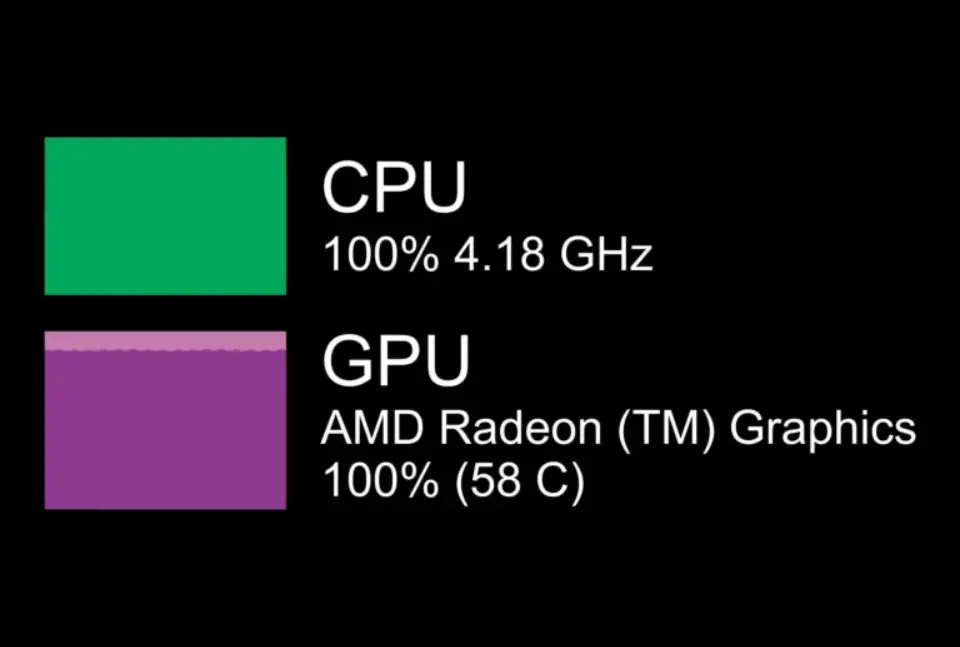
Low CPU Usage & Maximum GPU Usage
When CPU usage stays low but GPU usage reaches 100%, your system faces a GPU bottleneck. The task depends heavily on graphics power, and the graphics card becomes the limiting part. Lowering resolution or graphics settings can improve FPS, or you can upgrade to a stronger GPU for better gaming performance.
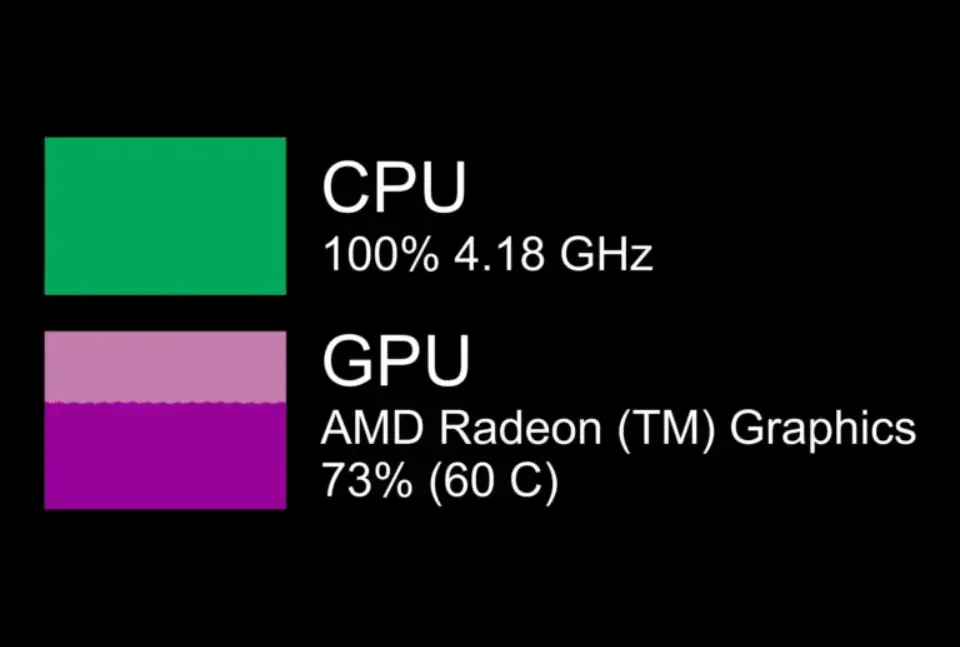
High CPU Usage & Maximum GPU Usage
When both the CPU and GPU show high usage, your system stays well balanced. The GPU may limit performance slightly, but this setup still delivers stable FPS and smooth results in gaming or rendering tasks.
Maximum CPU Usage & Low GPU Usage
When CPU usage reaches 100% and GPU usage stays low, your system faces a CPU bottleneck. The processor handles all the heavy work while the graphics card waits idle. This often happens in strategy games, simulations, or tasks with heavy background processing. Upgrading to a faster CPU can greatly improve FPS and overall system performance.
Maximum CPU Usage & High GPU Usage
When both the CPU and GPU stay active but the CPU hits 100% first, your system remains close to balanced. However, a slight CPU bottleneck may limit peak FPS during heavy scenes or intense gameplay.
Maximum CPU Usage & Maximum GPU Usage
When both the CPU and GPU reach 100% usage, your system runs at full capacity and uses all available power. This often happens in demanding AAA games or heavy rendering tasks. Make sure your cooling system works properly to avoid overheating and thermal throttling.
PC Build Comparison
| Component | Lite Build | Mid-Tier Build | Advanced Build |
|---|---|---|---|
| CPU | Intel Core i3-9320 @ 3.70GHz | Intel Core i5-13600KF | Intel Core i7-14700K |
| GPU | NVIDIA GTX 1650 4GB | NVIDIA RTX 3060 12GB | NVIDIA RTX 4070 Ti 12GB |
| RAM | 16GB DDR4 | 32GB DDR5 | 64GB DDR5 |
| Storage | 500GB NVMe SSD | 1TB NVMe SSD | 2TB NVMe SSD |
| Price Range | $500 – $600 | $1100 – $1300 | $2000 – $2500 |
Why Our Bottleneck Calculator is Better
| Features | Our Tool | Competitors |
|---|---|---|
| Component Coverage | CPU, GPU, Resolution, RAM, Storage, and Purpose. | Mostly CPU and GPU only. |
| Results Quality | Detailed performance reports with actionable insights. | Basic text-only result. |
| Upgrade Recommendations | Specific component upgrade suggestions based on balance score. | Generic advice like “Upgrade CPU”. |
| Mobile Friendly | Fully responsive for mobile and tablet devices. | Poor or outdated mobile layout. |
| Data Freshness | Updated regularly with modern CPUs and GPUs. | Often outdated hardware database. |
| Benchmark Source | Uses real benchmark-based performance data. | Estimated or simplified calculations. |
| FPS Estimation | Provides estimated FPS impact based on resolution. | No FPS guidance. |
| Bottleneck Percentage | Clear % score showing CPU or GPU limitation. | No clear percentage system. |
| Advanced Options | Storage type, RAM size, usage type analysis. | Limited configuration options. |
| User Experience | Clean UI, fast results, no signup required. | Cluttered interface or registration required. |
Advanced Guide to CPU and GPU Performance Bottlenecks
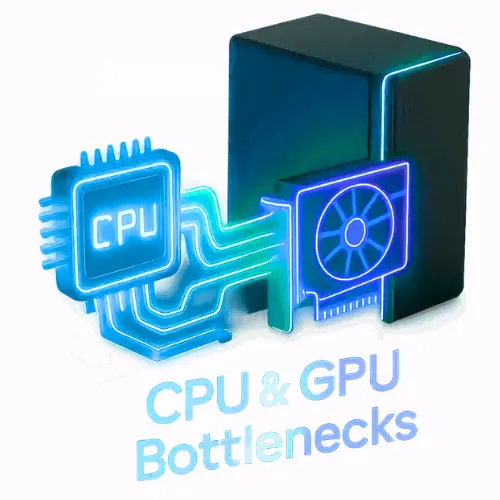
A bottleneck happens when either the CPU or GPU slows down the entire system. Even if you own high-end parts, a mismatch can cause low FPS, frame stuttering, or even overheating. When one component cannot keep up, the whole PC feels slower than expected.
Using a CPU bottleneck calculator or a full PC bottleneck calculator before upgrading helps you find out if your processor limits your graphics card. This prevents you from buying the wrong part and keeps your build balanced.
Gamers often notice frame drops, while content creators deal with slow rendering. Multitasking also becomes harder when background tasks overload the processor. Running a CPU and GPU compatibility check helps avoid these problems.
At higher resolutions like 1440p or 4K, the GPU usually handles most of the workload. If you pair a powerful graphics card with a weak CPU, performance imbalance becomes more visible. A proper bottleneck test ensures your system runs smoothly without wasting hardware potential.
Common Reasons for CPU Bottlenecks
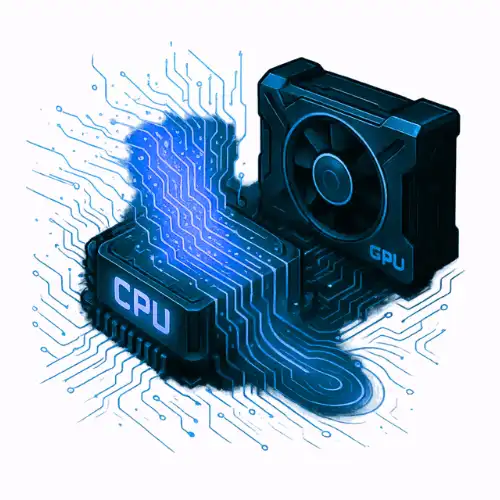
A CPU bottleneck happens when your processor cannot keep up with your GPU or heavy multitasking. Modern games and applications rely on higher core counts, faster clock speeds, and larger cache to run smoothly.
If you use an older or entry-level CPU, it can limit performance and cause uneven frame pacing, stuttering, or low FPS. This mismatch between CPU and GPU power often becomes the main reason your system feels unbalanced during gaming or demanding tasks.
How Upgrading RAM Enhances System Stability
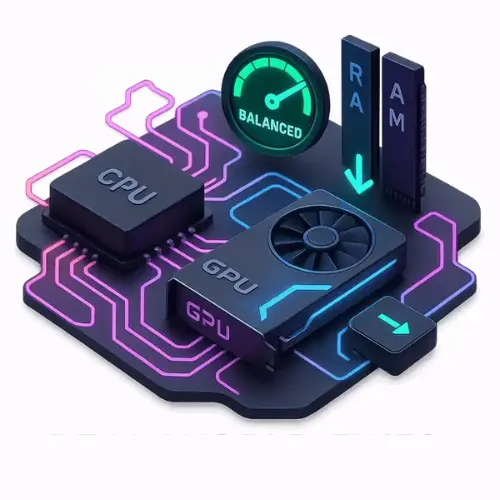
You run a system with a Ryzen 7 5800X and an RTX 3060, but only 8GB DDR4 RAM. Games take longer to load, multitasking feels slow, and stuttering appears often.
What went wrong:
- Modern games now require more than 8GB RAM to run smoothly.
- Low memory forces the system to use slower page file storage instead of fast RAM.
- Even a strong CPU and GPU cannot overcome a RAM bottleneck.
Smart Upgrade:
Install 16GB (2×8GB) DDR4 RAM at 3200MHz to balance the system properly.
Results After Upgrade:
- Faster game loading and reduced stuttering.
- Smooth multitasking with browsers, apps, and games running together.
- Stable and responsive performance during heavy workloads.
Bottleneck Percentage Explained in Simple Terms
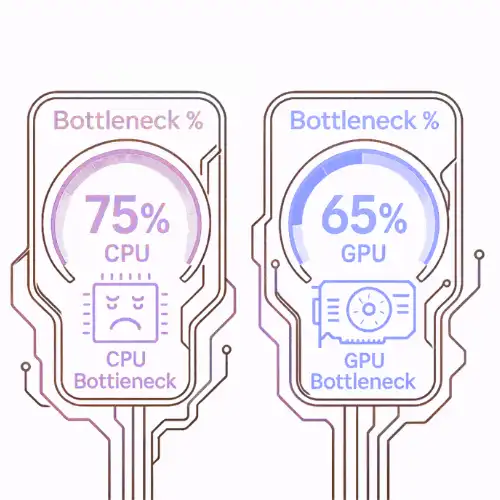
The bottleneck percentage shows how serious the performance limit is. A higher number means one part of your system holds back the other. The result clearly tells you whether the CPU or GPU causes the issue.
For example, a 75% CPU bottleneck means your processor is too weak or outdated for your graphics card. A 65% GPU bottleneck means your graphics card cannot match your CPU’s power and limits overall performance.
Reliable and Accurate PC Bottleneck Calculator
You can trust this PC bottleneck calculator because it tests real systems, not just theory. It uses updated algorithms and fresh benchmark data to deliver accurate CPU and GPU bottleneck analysis every time. The tool supports both older hardware and the latest processors and graphics cards, so it avoids the misleading results many basic bottleneck checkers produce.
This PC performance analysis tool focuses on real-world workloads instead of simple estimates, which makes it a dependable CPU GPU compatibility checker for gaming, editing, and multitasking setups. If you want a reliable way to check PC bottleneck issues, this calculator gives clear and up-to-date results for any build, whether you use an older system or modern high-end components.
Final Words
A PC bottleneck calculator helps you find which part of your system slows down performance, whether it’s the CPU, GPU, RAM, storage, or resolution settings. It shows how your components work together and gives smart upgrade advice to fix lag and improve FPS. By checking before upgrading, you save money, avoid compatibility issues, and keep your PC fast, stable, and balanced.